Will an additional state join NATO by 2024?
Published in March, 2022. Created by gmoss.
Disclaimer: This was written to participate in the "Impactful Forecasting Prize for forecast writeups on curated Metaculus questions" forecasting challenge. The thought process and the writing may improve with time.
Even though a lot can happen in two years, it is not a sufficient amount of time for a state to join NATO.
In two years the world has endured a pandemic and a war. The response to the pandemic from the scientists and the medical business sector was swift. As a result the global community got vaccines at record speed to deal with the new virus.
There is a specific process for developing vaccines. Opinions and time-pressure do not factor in the implementation of this process. No veto power either. This will change only if a better process is found and is proven to be effective.
A state joining NATO follows a process. It is a long process where opinions matter and a lot of people can say no. The process is deemed effective until it isn’t, and it can change at any time if some people decide and manage to agree to it.
In such a case, it is most likely that the process will remain a long one. The most recent addition to NATO was North Macedonia, which joined NATO’s Partnership for peace in 1995, and NATO in 27 March 2020 after it resolved its name issue with Greece. [PDF download]
It also means that an unexpected event could disrupt this process and change it. Based on the events of 2014-2022 this scenario seems unlikely to play out before 2024.
Events of 2014-2022
20 February 2014
Russia seizes Crimea.
15 April 2014
Ukraine declares Crimea as temporary occupied Russian territory.
5 September 2014
The Minsk Protocol aimed to stop the war in the Donbas region in Ukraine is signed by Ukraine, Russia and the Organization for Security and Co-operation in Europe.
It was not recognized by the leaders of the Donetsk People's Republic or the Luhansk People Republic.
The war did not stop.
12 February 2015
Minsk II
The agreement was not fully implemented.
The fighting did not stop completely.
Part of the agreement was the change in Ukraine's constitution to grant self-government in certain regions of Donbas.
Source: wikipedia Minsk Agreements
8 August 2016
Ukraine reports that Russia reinforced its military in Crimea.
2018-2020
More tensions.
February 2022
Russian armed forces enter Ukraine.
Source: wikipedia Russo-Ukrainian War
Example of NATO decision making process
The NATO 2030 initiative timeline:
December 2019
NATO leaders ask for a "forward-looking reflection process to strengthen NATO."
June 2020
Presentation of the NATO 2030 agenda.
June 2021
NATO leaders endorse the NATO 2030 agenda.
Sources:
NATO 2030 Factsheet[PDF download]
UPDATE APRIL 2022
Note 1 : The aim of this update is not to change the prediction, but to analyze it to help make better predictions in the future. Additionally, it is an effort to establish a process for making predictions.
Note 2 : Whenever a statement refers to something that is not purely an opinion and has not been fact-checked using even unreliable sources, then the words [NOT FACT-CHECKED] will appear at the end of the statement.
First a summary of the logic of the prediction above:
1. Previous acceptance into the alliance took years
2. The process of NATO decision making is lengthy: eg. 1 year to present and to endorse the NATO agenda
3. The process is complex because it relies on many different voices and weighted power
Process Step 1: look into what has happened in the past.
Process Step 2: consider the “why” behind what has happened in the past.
Important differences between the past cases which were not considered when making the prediction:
1. Previous country membership acceptance took years after the country formally asked for membership, because there were ongoing disputes with other country members, once the disputes were resolved acceptance moved forward
2. Finland and Sweden so far had chosen not to be members of NATO, there were no ongoing disputes with other country members [NOT FACT-CHECKED]
Process Step 3: look at differences between what is happening now and the past.
New developments
There have been articles in the press about one, public sentiment in Sweden and Finland changing to a more favorable position about the countries joining NATO and second, about Finland formally making an application to join NATO.
If an application is submitted this June then NATO’s decision-making process timeline of six months (June/December meetings) to one year (for making a decision) is enough for a country to join NATO before 2024.
Although the prediction thinking accounts for a potential expedited process, not considering past differences makes it less reliable.
Nevertheless, the “no” prediction weighted heavily NATO’s decision-making being a complex process based on varied voices and weighted power among members.
Will statements from Russian officials about any bordering country with Russia seeking NATO membership suffering consequences be a reason for extended debate among NATO members?
Also, it discounted the possibility of a country joining NATO before 2024 based on the lack of such action despite similar military developments between Russia and Ukraine in 2014 (Crimea).
This means that despite not considering all available information and regardless of current developments the prediction would remain the same.
In this case, however, important questions arise:
Why now?
Why not in 2014?
What has changed?
What do those changes mean?
UPDATE 25/01/2023
Just a day ago this prediction update would have been a lot more cautious without a change in probabilities.
Not today.
The following tables were created based on recent news articles.
Table 1
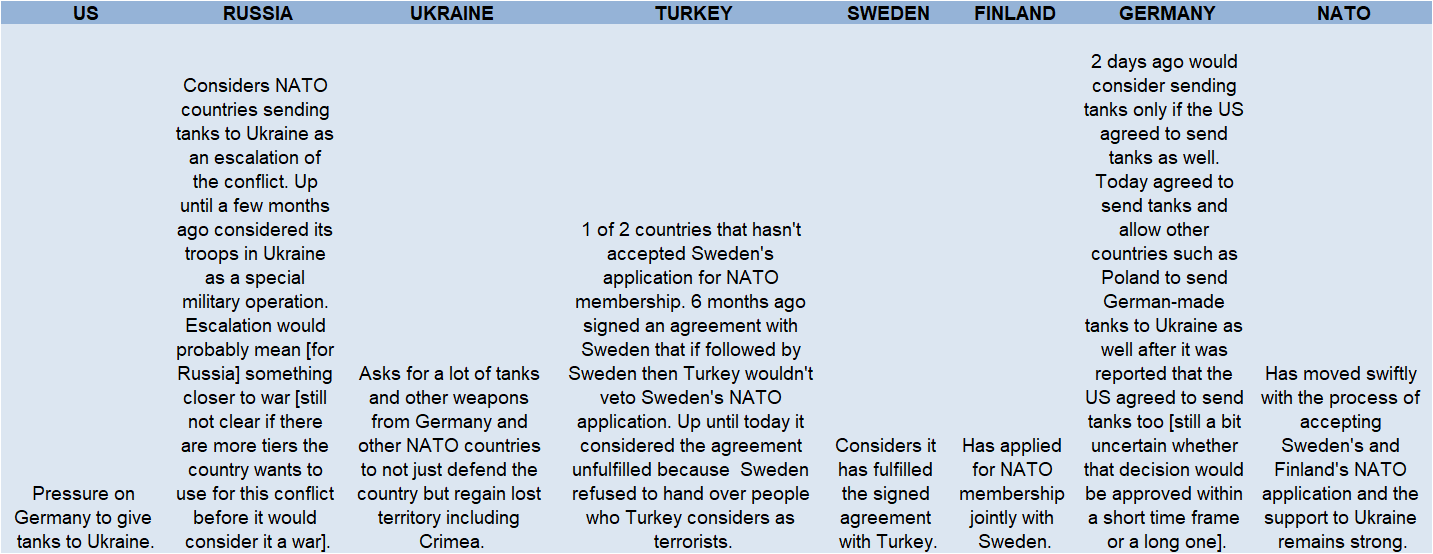
Table 2
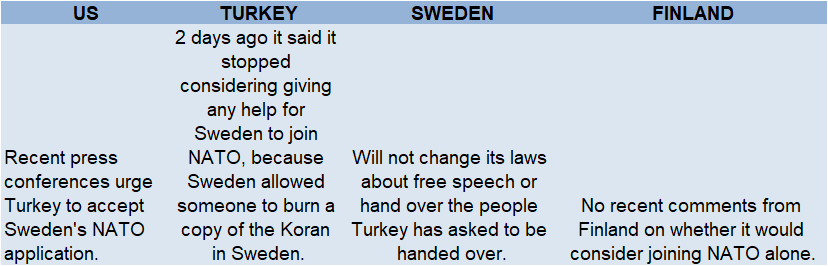
Table 3
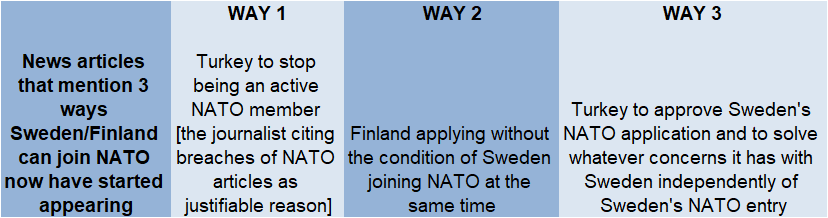
From the above tables, the casual news reader is left with the impression that NATO is determined to have Sweden and/or Finland as members within 2023 and will apply the right pressure and move fast in order to accomplish it.
Therefore, despite recent developments supporting the prediction and the reasoning behind it, this long term prediction which was made in March 2022 would change today.
Solely based on the sentiment from news reports about the desire of formally having Sweden and/or Finland as NATO members within 2024 the prediction would change from negative to positive. [the question being “Will an additional state join NATO by 2024?”]
More specifically, we would assign a 0.80 chance on the original prediction when it was made in March 2022 and would now, January 2023, change that chance to 0.40. This action would be taken with high uncertainty considering that:
1. NATO response in 2014 was nothing like the response in 2022
2. Any NATO article infraction anyone might cite as grounds for Turkey to leave NATO is long standing [Turkey didn’t change its stance or actions within the past year]
3. NATO support to Ukraine has been strong from the beginning without Ukraine being part of NATO
4. Sweden and Finland cooperation with NATO has been strong through the years despite not being NATO members and being considered neutral
The four points above, along with all developments since the prediction was first made in March 2022, indicate that established processes, values/beliefs, treaty articles and past or current actions have no strong weight in making a prediction in this case. One can count only on the prevailing sentiment, a factor that can change as easily and unpredictably as the wind.
UPDATE 05/04/2023
As of 04/04/2023 Finland is an official member of NATO.